DIY on Pinterest: Content that performs and ideas you can try
August 1, 2026
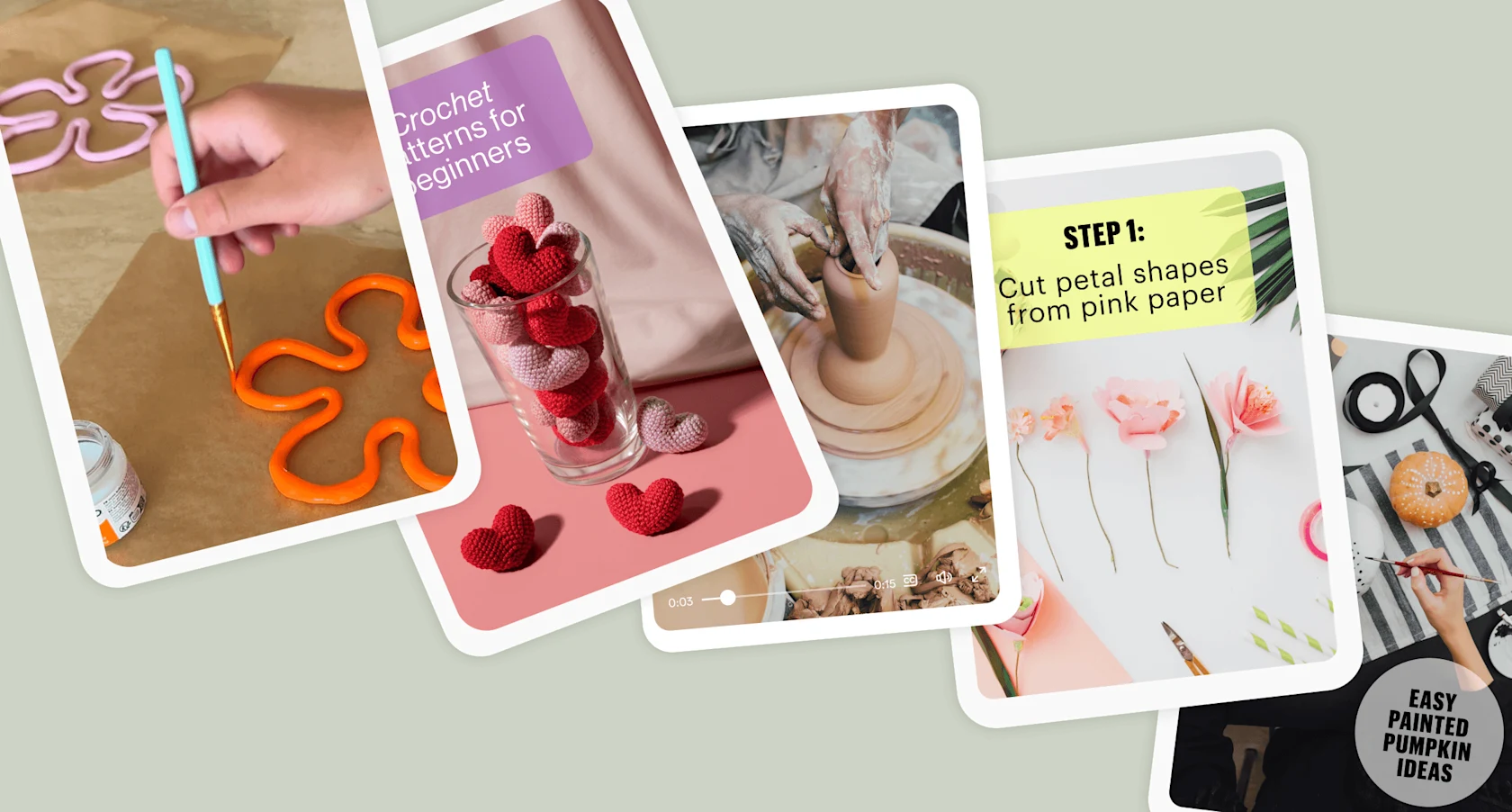
DIY content keeps growing on Pinterest. If you’re creating in this space, it may help to know what shows up again and again in content with strong engagement.
To get a sense of what tends to perform well in DIY on Pinterest today, recent internal analysis of high‑engagement DIY content found six key ways creators tend to make those Pins. Use them as inspiration and try the approaches that fit your style in your next Pins.
1. Start with themes that people already love
When you know where interest is already high, it’s easier to pick project ideas that people might be looking for. In DIY, certain project types show up often in content with strong engagement.
For static Pins, that includes knitting and crochet, card making, embroidery, stitching and sewing. For video Pins, some of the themes that appeared most often were polymer clay projects, DIY books and journals, and DIY flowers made from paper, fabric or clay.¹
What to try: If you’re aiming for saves, focus on clearly photographed, step‑by‑step projects in these popular categories, and if you’re aiming for clicks, test adding practical details such as supply lists, patterns or templates that people can tap through to get.
2. Match your format to your goal
Different projects shine in different formats. Quick ideas and simple crafts often work well as single‑image Pins or short clips, while more involved builds benefit from multi‑step formats.²
Static Pins can highlight the finished project in a clean, styled shot. Collage Pins make it easier to show the main steps or before‑and‑after in one view. Video gives you room to walk through the process in real time or as a fast, satisfying transformation.
What to try: If you’re aiming for clicks, test static or collage Pins that feature the finished project clearly and hint at instructions or patterns on your site; if you’re aiming for saves, use multi‑image Pins or videos that walk through the key steps that people will want to revisit.
3. Make every step easy to follow
DIY succeeds when people feel like they can actually do it. Short, clear steps—visually and in your text—showed up often in high‑engagement Pins. Numbered steps, simple labels or brief notes about time, tools or difficulty can all help people to understand what’s involved at a glance.
What to try: Use close‑ups or separate frames for each major step, and keep any on‑image text to a few words that label what’s happening (‘cut’, ‘glue’, ‘paint’, ‘assemble’). Save longer instructions, measurements and safety notes for your description or destination link.
4. Show tools, materials and your workspace
People often decide whether to try a project based on what they already have to hand. DIY Pins that clearly showed tools, materials and a realistic workspace made it easier for people to picture themselves doing the project.
What to try: Start with a frame that lays out the key supplies, or include a simple tools‑and‑materials panel in a collage. Keep your workspace tidy enough that tools are easy to spot, but not so polished that it feels unattainable. Identify any speciality items in your description so that people can plan ahead.
5. Highlight progress and the final reveal
For many DIY projects, the ‘in‑between’ stage is just as important as the ‘after’. High‑engagement Pins often showed the project at a few distinct stages—before, in progress and finished—so people could see the transformation.
What to try: Pair a strong before‑and‑after with one or two in‑progress shots or clips that show the most satisfying moments (such as peeling tape, adding colour or assembling pieces). Make sure that the final frame clearly shows the finished project in use or styled in a real space.
6. Lean into problem‑solving and repurposing
A lot of popular DIY content solves a specific problem: organising a messy space, fixing something that’s broken or turning leftover materials into something new. Upcycling, budget‑friendly ideas and small‑space solutions appeared often in Pins that people saved and clicked.
What to try: Frame your project around the outcome that it delivers (‘hide cords’, ‘save counter space’, ‘reuse scrap wood’) and use your title, overlay text and description to make that benefit clear. When a project uses affordable materials, scraps or items that people already have at home, say so.
Experiment with your approach
A few simple best practices can also support discovery: design for mobile with vertical formats, use relevant keywords in titles and descriptions, and keep your profile curated and up to date. From there, pick one of these moves and test it in your next few DIY Pins, then see how your saves and clicks respond.


